Grimer and Muk

bills-pokedex:

Grimer
The Sludge Pokémon
Type: Poison
Official Registration #: 88
Entry: Born from polluted rivers, this pokémon’s body consists entirely of highly toxic sludge. It consequently thrives on pollution, and as such, it flocks to polluted waterways, where it has been known to clog up entire sewer systems in its zeal to consume raw waste. Despite all of this, grimer populations are considered to be the most prevalent in Kanto and Hoenn, home to two of the most aggressive green campaigns in the world, despite the fact that other regions historically had difficulties with pollution, are centers of mining and manufacturing, and are currently so polluted that their environment has given birth to sentient garbage bags.

Muk
The Sludge Pokémon
Type: Poison
Official Registration #: 89
Entry: The evolved form of grimer, by battle experience. Like its preevolved form, a muk’s body also consists entirely of a highly toxic sludge. However, due to its increase in mass, power, and age with evolution, muk is able to cultivate highly powerful strains of bacteria and viruses that infest every inch of its skin. Physical contact with this pokémon can kill plants and smaller or weaker animals on contact … which should speak volumes about the resilience of pokémon researchers and their assistants as a whole, considering the fact that certain muk express affection via alarmingly frequent tackling.

Grimer (Alola form)
The Sludge Pokémon
Type: Poison/Dark
Official Registration #: 88
Entry: This sludge-like pokémon actually descends from grimer imported from Kanto. Decades ago, when Alola was facing a pollution crisis, the regional government took notice of how grimer consume waste and attempted to bring in a small but tame population to consume the considerable amounts of garbage clogging Alolan streets. Naturally, some of these grimer escaped and reproduced, and over generations, they mutated to match their comparatively less toxic food sources (that is, compared to the diets of standard grimer) … as well as the psychic and steel predators also brought in to handle the out-of-control grimer population. Long story short, this is exactly why: A) there are infestations of grimer, abra, and magnemite in certain parts of Alola, and B) coming up with good ideas should not be left to people in politics.

Muk (Alola form)
The Sludge Pokémon
Type: Poison/Dark
Official Registration #: 89
Entry: The evolved form of the Alolan variation of grimer, by battle experience. Despite its fangs and sharp spikes, this highly colorful pokémon is actually sweeter, gentler, and far less fragrant than its standard cousins. Additionally, its skin is comparatively clean, making it safe to touch. However, contrary to popular belief, it’s often a bad idea to hug one unless you’re experienced with training this variation of muk, as both its bodily fluids and its spikes are highly toxic. Naturally, considering the toxicity of certain parts of its body, combined with its vivid coloration and docile nature as well as the Alolans’ general ability to make sound decisions, most residents of Alola consider their variation of muk to be a highly popular mascot for children’s programming and products.
Grimer/Muk make wonderful companions once you get over the smell, my little Alolan Muk named Diesel is just the sweetest thing!

This is absolutely true, anonymous. Many trainers are perfectly happy with their grimer and muk. It’s just important to wash one’s hands after handling them, even if you’ve acclimated to their smell.

(Although, of course, it should also be noted that Alolan grimer and muk lack the standard form’s signature odor, so actually, members of that particular breed are even better choices for those who can’t imagine ever getting used to a grimer’s stench … as unfortunate as that may be.)

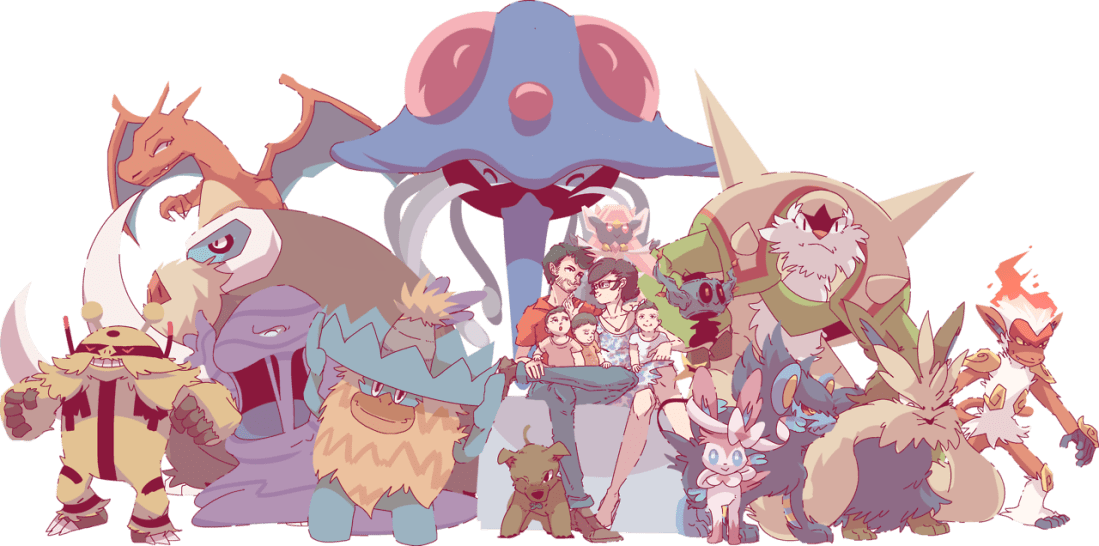
My wife and I had triplets not to long ago. We were finally able to get a family portrait together after hours of the photographer trying to get everyone in place and trying us trying to get our Pokemon to cooperate (along with our dog too!). Should we be worried about any of our Pokemon and the triplets as far as our Pokemon getting along with the new additions? Do you see any concerns here? So far Luxray seems to be the most protective of our bunch. Thoughts?


Bill: First and foremost, congratulations! You look like a wonderful family.

That said, though, my only concern is with your muk, rather than your luxray. Your luxray is displaying normal behavior around new additions, so I would only worry about it if it’s aggressive towards you whenever you try to take the children back.

Your muk, on the other hand, is a different story due to the fact that its body naturally harbors a wide variety of microfauna—or, in other words, potentially harmful bacteria and viruses. Newborns should be kept away from muk until you’ve started on their vaccination schedule at the very least (although really, preferably until their immune systems further develop), even if muk is eager to help.

Other than that, at first glance, it seems like the rest of your pokémon family don’t mind the presence of your children at all, which is a good sign. If that’s the case, then they likely understand how to regulate their power around the babies, meaning they’re docile enough to handle them without issue.

Best of luck to your family!

on pokemon stench, I would like to mention that it is entirely possible to find grimer and muk that dont smell at all. These are the ones without the ability “Stench”, generally. I really wish more people would realize that not all of these goopy friends smell awful….. They still are pretty toxic though.

Actually, all of them do smell due to the combination of chemicals and bacteria in their bodies. It’s just that some grimer and muk’s bouquet of aromas are more subtle than others’, and in any case, the longer you spend with a grimer or muk, the less you notice their stench.

Speaking of which, it’s true that grimer and muk with the Stench ability possess more potent aromas than those without, to the point where they’re able to weaponize it (as opposed to making use of their sludgy, amorphous bodies or their toxic composition, as with Sticky Hold/Gluttony/Power of Alchemy or Poison Touch, respectively). These pokémon are indeed harder to become acclimated to, so whereas the scents of Stenchless grimer and muk are actually rather bearable after a while (perhaps even pleasant to a number of people), the scents of those with Stench may be a different story.

Nonetheless, though, I agree that grimer and muk are a highly misunderstood pokémon, and even if they do possess rather odd aromas, this should be no deterrent to a human trainer.

Just … don’t handle them with bare hands. Trust me on that.

what are common pokemon used in modeling?

Practically all of them, anonymous. The modeling industry consist of highly creative individuals, and many agencies emphasize the idea that quite literally anyone and anything can be a model. It’s admirably progressive, in my opinion. Especially considering the fact that I never would have been able to conceptualize using a muk as a model, yet one of our most famous pokémon models is a Kantonian muk named Fragrance.

I recently received an Alolan Muk as a present from an old friend of mine… but I live in Sinnoh. How can I help her adjust to the colder climate?

Ah, your friend chose well. While it’s true that Alolan muk must be acclimated to cold temperatures (due to the fact that their bodies are primarily composed of actual liquid), they’re among the easiest pokémon to introduce to cold weather.

To do this, begin by keeping your muk indoors. If you live anywhere else but Snowpoint and if it isn’t winter, you can actually allow your muk to spend time outside for any length of time she can tolerate. Try to encourage her to increase the amount of time she spends outside little by little until she adjusts. If it is winter or if you do live in Snowpoint, however, the acclimation process should start by allowing her to wander about your home for any length of time she can tolerate, then withdrawing her into her poké ball to rest. Once she adjusts to your home, then she can move outside. Always watch for signs of freezing, however, such as spots on her body that seem a little stiff or the formation of frost. If you see any sign that she’s freezing over, immediately bring her inside and allow her to thaw by a heater or beneath a set of blankets.

Best of luck, anonymous!

So Bill, when do you think we can get Entries on Alolan Grimer and Muk? And is it true that non-Alolan Grimers and Muks are possibly going extinct? I’m worried for my blob-shaped friends!

I’ve actually been considering tackling all Alolan variations at some point, as each one of them is so vastly different from their outside counterparts that it’s often inadequate to simply address one form but leave the other completely out of the picture. (On a similar note, I’m still intending on covering mega evolutions for the same reason.) I just don’t entirely know when—perhaps when I’ve completed the main entries for each currently indexed pokémon.

As for whether or not non-Alolan grimer and muk are going extinct, that’s true … within Alola, anyway. It’s a mixed blessing, really. While on the one hand, a sharp decrease in any pokémon population is always unfortunate, but on the other, high populations of grimer and muk indicate severe issues in the habitability of a biome. A decrease in their populations, then, would mean an increase in the populations of many other species of pokémon.

Still, for those of you who may be fond of the grimer family, rest assured that there are still plenty of cities in the world with sufficient enough pollution levels to maintain healthy grimer and muk populations. Castelia City in recent years, for example.

trainzelda
replied to your post “So Toxicroak sounds dangerous to even be around, how is it that people…”

I thought they meant, like, how are you supposed to care for toxicroak if you can’t even touch it?

With extreme caution.

In all seriousness, though, as toxicroak are among the more humanoid pokémon in existence (even if it otherwise appears to be a giant frog), it will do much of the work that would require physical contact itself—namely grooming. Beyond that, many of the tasks involved with taking care of a toxicroak don’t require physical contact at all, and toxicroak are not particularly fond of physical forms of affection, either. At most, you may be at risk for toxin exposure whenever you clean its habitat, but this is why toxicroak handlers recommend installing filters (and wearing gloves when changing these filters) to help regulate toxic buildup in their ponds or pools.

More volatile pokémon such as muk may be a bit more of a challenge, but there’s some evidence out there that muk can actually control its toxicity and how much bacteria it harbors. No one’s quite sure how, exactly, but seeing as Professor Oak has yet to succumb to muk poisoning (or any other sort of injury resulting from periodic Body Slamming via muk), we’re reasonably sure that it’s fully capable of regulating its biochemistry.

Either that or Professor Oak is far, far more resilient than the average human being. You know, the scientific community isn’t actually sure which, so this may perhaps be a bad example.

Thank you so much for your help with my Grumpig and Feebas I took everything you said into consideration and I found out the river where I was hunting down a prism scale (which are really rare in alola) was actually an alola form Muk! My Grumpig knew the waters were a site of one of the trash storing places and a muk had escaped so we up and left to find the scale my Pokemon now get along very well! Thank you so much!!

Glad to hear that the issue has been resolved, @deliriousfan606, and it’s great to hear that your grumpig and feebas are doing well together now! Not to mention, of course, that it’s quite wonderful to hear that your grumpig actually cares for his teammate so much that he would go to such lengths to protect her from a literally toxic environment.

(Of course, it’s also worrying that the environment in Alola can be so volatile that a rainbow-colored muk can be mistaken for a river, but I suppose that’s neither here nor there.)

In any case, it is quite fascinating to know that pokémon are so much more aware of our shared environment than we are. Your grumpig seems incredibly loyal and wise, so may he continue to give you trustworthy advice from here onwards.

Grimer and Muk

Grimer
The Sludge Pokémon
Type: Poison
Official Registration #: 88
Entry: Born from polluted rivers, this pokémon’s body consists entirely of highly toxic sludge. It consequently thrives on pollution, and as such, it flocks to polluted waterways, where it has been known to clog up entire sewer systems in its zeal to consume raw waste. Despite all of this, grimer populations are considered to be the most prevalent in Kanto and Hoenn, home to two of the most aggressive green campaigns in the world, despite the fact that other regions historically had difficulties with pollution, are centers of mining and manufacturing, and are currently so polluted that their environment has given birth to sentient garbage bags.

Muk
The Sludge Pokémon
Type: Poison
Official Registration #: 89
Entry: The evolved form of grimer, by battle experience. Like its preevolved form, a muk’s body also consists entirely of a highly toxic sludge. However, due to its increase in mass, power, and age with evolution, muk is able to cultivate highly powerful strains of bacteria and viruses that infest every inch of its skin. Physical contact with this pokémon can kill plants and smaller or weaker animals on contact … which should speak volumes about the resilience of pokémon researchers and their assistants as a whole, considering the fact that certain muk express affection via alarmingly frequent tackling.