I read in the dex recently that male salandit dont evolve due to malnutrition from giving almost all of their food to the females. Is this true? It seems like we would see male salandit evolutions with trainers if it was true. I know I keep mine well fed and in great health.

It’s true. In a way, anyway. It would actually be more accurate to say it was true eons ago, although yes, wild salandit do indeed display this behavior today. Still, even if you removed such a salandit from contact with a female and fed him well, he still wouldn’t evolve.

This is because of adaptational evolution. While female salandit retained their ability to evolve (so they can get stronger and lay and protect their eggs on their own), male salandit adapted towards a form that would allow them to survive while still devoting the majority of their available food to females, who need the energy more. Eventually, males simply lost their ability to evolve altogether, as their salandit forms were better suited to survive such an arrangement.

It’s actually a very fascinating subject, and it’s been the subject of thorough discussion in the scientific community since salandit’s discovery.

dzamie:

scientificpokedex:

Requested by @mobiustwixt and anonymously

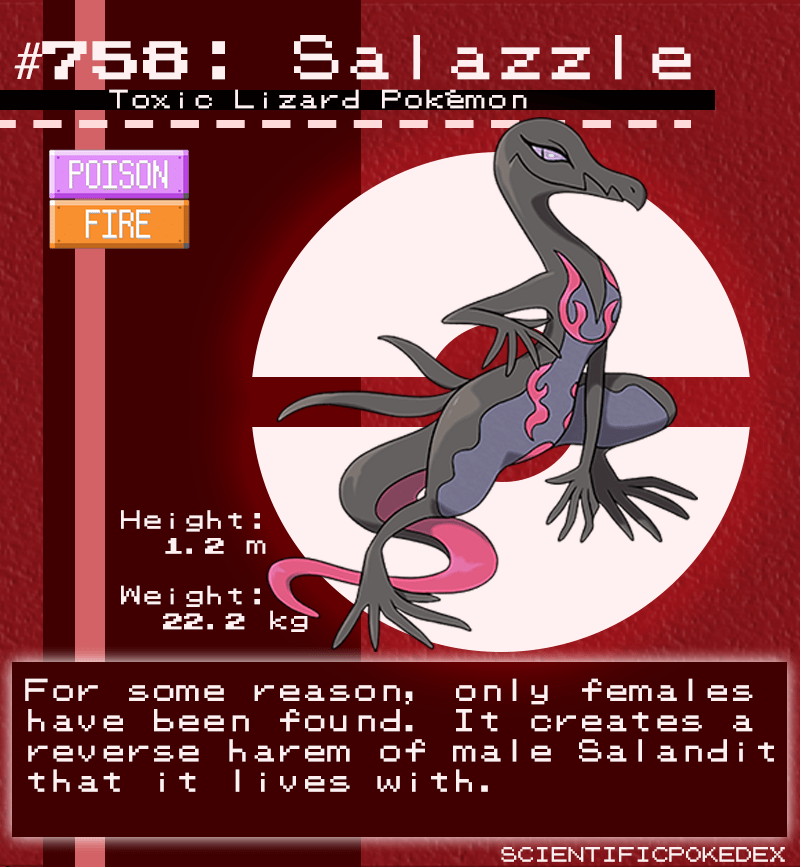
There’s quite a few pokémon that are all female, and Salazzle joins their ranks in gen 7. Only female Salandit are capable of evolving. It may sound strange, but there are quite a few organisms in our world that are like Salazzle, where only the females ever reach full maturity. Many of these species are parthenogenetic, meaning they don’t even need males to reproduce. They can still have sex, but even if they don’t, they can lay an egg that’s never been fertilized and the egg will still hatch. Whiptail Lizards, Komodo Dragons, Mole salamanders and some frogs are able to do this.

image

In fact, about one third of all whiptail species are entirely female: the male has gone extinct altogether. But, since there are still plenty of male Salandit around, Salazzle isn’t quite like these lizards. 

Most animals (humans included) are diploids, meaning we carry two sets of chromosomes. Salamanders that are parthenogenetic often have three, four or five sets of chromosomes: this helps ensure that even though an egg might never be fertilized, it won’t be a perfect clone of its mother when it hatches. Genetic diversity is important for a species survivals: a group of identical clones would not survive for long.

So how can an egg hatch if it’s never been fertilized? In human reproduction, the child inherits half of their chromosomes from each parent. For example, for the chromosomes that determine sex, females have XX and males have XY. A child will inevitably get one from each parent, an X from the mother and either an X or Y from the father. 

In a parthenogenetic example, the chromosomes that determine sex for a Komodo Dragon are called W and Z, not X and Y. It’s also a bit backwards from human reproduction: a male komodo dragon has ZZ, and a female has WZ. Each Komodo dragon egg laid by a female has either a W or a Z. In parthenogenesis, the chromosomes in the egg duplicate themselves, becoming either WW or ZZ. Just like YY is not an viable combination in humans, WW is a not a viable combination and will never hatch. ZZ, on the other hand, makes a male komodo dragon, so every unfertilized egg that hatches will be a male. Eggs that have been fertilized by a male can hatch either as male or female.

This explains why there’s so many more male Salandit than females! If a Salazzle’s egg is never fertilized, it will hatch into a male Salandit. If the egg is fertilized, it will be either a male or female Salandit. 

Salazzle is a parthenogenetic organism: it can reproduce without having sex, and unfertilized eggs will always hatch into male Salandit.

@bills-pokedex @elektronx

How do gender based evolutions work? (Specifically Gallade, Froslass, and Salazzle, Vespiquen is kinda obvious)

Well, Gallade and Froslass’s evolutions are determined by genetics, as noted here: http://bills-pokedex.tumblr.com/post/149893951891/a-recent-ask-about-gallade-got-me-wondering-why

Salazzle is a bit more complicated, and it’s actually far more interesting. You see, one of the hallmarks of a salazzle is her ability to attract and enrapture male salandit. She does this through the release of powerful pheromones, which are emitted through scent glands located under her tail and on the red markings in her chest.

The reason why I bring this up is not because these scent glands are directly responsible for a female salandit’s ability to evolve. Rather, they’re directly responsible for the males’ inability to do so. To put it in short, these scent glands are present in female salandit as well, and although they are far from as powerful as a salazzle’s collection of glands, they still do the job just as effectively. Between salazzle and female salandit, male salandit often find themselves at the beck and call of half their species for the majority of their waking lives. They’re compelled to expend much of their energy building nests for and protecting females (as well as their eggs), and much of the food gathered by a reverse harem of male salandit (that is, incidentally, the actual, scientific term for it) is given to nesting females. Consequently, male salandit often lack the energy to evolve, if they’re not simply too underdeveloped from malnutrition to do it.

Of course, one might ask if it’s remotely possible for a rebellious male salandit to achieve evolution, but I’m afraid there are two issues with that. First, while it’s true that there might still be outliers, it’s widely believed that the salandit species has gone on this way for so long that male salandit actually lack the ability to evolve on a genetic level—as in, they lost their ability to evolve via adaptation. Second, even if they hadn’t, a female salandit’s pheromones are much too powerful for a male to resist. And to those of you who question how one can be virtually incapable of dodging a request from someone with whom you’re thoroughly in love … try rebelling against your significant other when they ask you to put the wet laundry in the dryer. See how well that goes for you.

Bill, can you really make that kind of claim when you haven’t dated anyone in years? —LH

Of course I can. By the way, your shirts have about ten minutes to go, and you’re welcome. —Bill

…this is one of those times when I try to be clever and realize all too late that it went horribly wrong, isn’t it? —Bill
Hello there! I have a Salazzle among my mostly male team and I noticed that she hasn’t established a reverse harem which Salazzle are known to do. Is normal? Thank you in advance and have a nice day.

Absolutely. Some salazzle just aren’t interested in forming breeding groups, either because they prefer the company of female pokémon or simply don’t wish to breed at all. You could try placing her with female pokémon to see what her reaction is, but even if she expresses no interest at all, then always do your best to support her and her decisions.

I got a present of various scented things shampoo, body was, Ect tried it all out at once came out vary nice. My male Pokemon thought so to, and are realy “affectionate”. Looking it up it seams some of the stuff contained Salazzle pheromones. I left them at a daycare becuse they where getting frustrated and fighting. it’s bin a few days and every time I see them they seam to still be affected. Is thier a way to get it off or should I give up and see what happens

As a scientist, I’m inclined to advise you to do the latter.

As a decent human being, however, mix baking soda with shampoo (preferably not the same shampoo as the one that caused this problem in the first place), wash normally, and rinse thoroughly. That should do the trick.

When my salazzle and I travel salandit flock to her and follow us. Why is this? How do I get them to stop?

As you might have seen from the salazzle entry posted shortly after we received this ask (and I do apologize for the delay!), salazzle excrete powerful hormones that attract every male salandit in the vicinity. This is an unconscious act, and it’s basically a survival mechanism. Because female salandit (and by extension, all salazzle) are extremely rare, it’s necessary for a salazzle to be able to make herself as appealing as possible to ensure she breeds and thus perpetuates the species. The fact that males obey her and form a harem around her is part of this survival mechanism as well (not to mention it also explains their behavior towards yours).

Unfortunately, because all of this is inherent in the salandit line, it’s extremely difficult to stop it from happening. You can, however, apply synthetic scents (that is, perfume) to your salazzle to mask her scent and mix with her pheromones in ways that are unpleasant to salandit, but this may be uncomfortable to your salazzle herself. It may be worth trying, however, if her harem is interfering with her day-to-day life with you.

Alternatively, having her lay a nest of eggs typically causes the males to flock towards the nest, rather than towards the mother, as they become far more interested in fertilizing and protecting the eggs at all costs. So, quite literally, allowing her to breed may be another method.

Best of luck, anonymous!

Salandit and Salazzle

Salandit
The Toxic Lizard Pokémon
Type: Poison/Fire
Official Registration #: 757
Entry: A salamander pokémon native to tropical regions. More specifically, it lives on the craggy slopes of active volcanoes, where it mixes its own toxic gas with gases of its environment to create a noxious but sweet-smelling perfume. This perfume has the ability to not only lure in prey but also disorient them, allowing salandit—which, incidentally, normally travel in packs—to draw prey close enough to attack. These noxious properties have not gone unnoticed by humans, of course, and as such, certain groups have figured out how to refine and bottle these gases to produce the exact thing you think they would: perfume.

Salazzle
The Toxic Lizard Pokémon
Type: Poison/Fire
Official Registration #: 758
Entry: The evolved form of the rare female salazzle, by battle experience. Each salazzle possesses an abundance of pheromone glands. Due to their rarity and these pheromones, salazzle have the tendency to attract mass amounts of male salandit wherever they go. These salandit then become integrated into each salazzle’s reverse harem, and yes, there have indeed been plenty of ridiculous shoujo anime titles made from this exact premise.