image

Not again Bill!


Edit:

Bill … care to explain how the internet has a shot of this? —LH

Well, there’s a possibility that the footage from one of the cameras I’d set up saved a backup copy to the cloud, and it was somehow leaked to the general public. Clearly, this means I’ll have to have a word with the other administrators. —Bill

…. —LH

…I was recording a test run of the teleporter for science. —Bill

Are you sure your accidents were actually accidents? —LH

Bill, the kajiwoto pets bot code you type for eevee on DisPokécord is pet egg 66Jl

I hope this makes your day. 🙂

https://cdn.discordapp.com/attachments/501427639479697667/502569777290805268/a2fqatexlm_rvlpua_1539850695940.gif


Bill: I was having an excellent day before this, but now it’s even better. Thank you!

Any video games you really like to play, Bill?


Bill: Admittedly, unlike Molayne, I haven’t quite figured out how to balance work and gaming—which is to say, after work, social media, and basic self care, I don’t really have much time to play video games.

Still, I find sim games like Groundcraft (both alone and with others) and Minior Valley very soothing, as is Pokémon Crossing. I also like a few MMO and co-op games like Battlecraft (which is how Lanette and I met Molayne, actually) and Overheat, but only if Lanette and/or Molayne are also playing. I’m the one who usually mains healers, incidentally, largely because Molayne plays tanks, Sophocles (who is always online alongside Molayne) is very fond of rogues and stealth-based characters, and Lanette plays anything that can kill an entire map full of enemies the fastest. Sometimes Bebe joins us so we can have parties of five; she and Molayne take turns tanking.

I also occasionally play Don’t Faint with Bebe, but I’ve been barred from ever using the one character who starts off with a lighter because I “wouldn’t take the game seriously.”

Meaning I might have burned down the forest we set up camp in.

Repeatedly.

Hey Bill,

So I was lucky enough to find and befriend a Beldum that was hiding at our local recycling plant. It’s in great shape now and I’ve wanted to learn how to battle for a long time so we took to training. Everything started off just fine but Beldum seems to be slowing down and getting discouraged after using Take Down. I don’t know if I’ve been caring for it improperly or what’s going on but I don’t want to push Beldum farther than I should.


Bill: Well, Take Down literally does wear a pokémon down each use. You can help your beldum recover and avoid any permanent damage by ensuring you’re giving it proper care between battles. Feed it a high-mineral snack after each battle to help it rebuild its shell, and consider including supplements to keep its energy up, reinforce its immune system, and supply it with additional iron for rebuilding its body. Moreover, always polish it using mineral oil and a soft cloth. Never use an abrasive cloth or water.

Also, as counterintuitive as this might sound, break your training up into more manageable periods. If your beldum can’t go for a full hour, pull back and train it for half-hour, twenty-minute, or other easier increments. Give it at least five-minutes (preferably more) of rest between each session, then go at it again. If you try to do the whole hour, it’s more likely that your beldum will tire out more or hurt itself in a way that isn’t quite as easy to recover from.

Finally, keep in mind that lethargy may also indicate that it’s saving energy for an oncoming evolution. While there’s not much you can do to help it evolve beyond training, creating manageable training sessions and helping it recover from each one will keep its spirits up and encourage it to keep going until it evolves.

Best of luck!

Bill, do you subscribe to the theory that humans originally came to this world from another planet or dimension, or do you believe that we descended from pokemon?


While I’m open to practically any theory, I actually subscribe to the idea that we were descended from members of Kingdom Animalia right here on Earth, not, well, pokémon or aliens. There’s actual fossil evidence that strongly suggests this.

Granted, I fully understand why there are theories to the contrary. Our intelligence, resilience, and occasional gifts (that is, Aura channeling, psychic ability, and so forth) do indeed present strong arguments that we’re collectively a lot more special than, say, a house cat or a goldfish. However, it’s really more likely that we simply adapted to possess the traits we do because we interact directly with pokémon. Of course we would adapt to survive a Thunderbolt from a mischief of angry pikachu; our ancestors had to deal with much worse.

On the other hand, this all is only a theory. Where we actually come from and how we came to be what we are is still a bit of a mystery to scientists, and it’s one of the greatest mysteries we have yet to definitively solve.

Hey Bill, sorry about the length, but I’m hoping perhaps you could help me figure out what’s happening to my Alakazam. I’ve had him since I was a little girl and he’s always been my best friend, but lately he’s been distancing himself. He no longer wants to join me on trips to the lake or walks in the park when I’m off on my work rotation. He’s been sleeping much more than usual and has been much slower in reacting or answering me when I address him. He’s never been a big eater but now he hardly eats a complete meal once a day, no matter why I try to give him. His fur has also thinning in patchy areas despite how well it’s kept. Is there anything I can do for him, to keep things from getting worse?


Bill: Well, if your partner had been an alakazam since you were young, there’s a good likelihood that he’s … well, getting old. For one, if he evolved naturally, then by default, he’s likely pretty advanced in age. For another, if he hadn’t, alakazam don’t live that much longer after evolution. I don’t mean to say that they live short lives afterwards, of course; I mean to say that they don’t often live as long as their human partners. Sometimes, they don’t quite make it to twenty years after their final evolution. The stress of containing their incredible psychic abilities can take a physical toll on them, you see.

I know that sounds quite depressing, but alakazam frequently deal with the subject with grace, as yours seems to be. Many of the signals you’re describing match up with classic behavior for when an alakazam is, well, making its final preparations. Of course, I could be wrong, and it’s important to communicate with your local pokémon center to be absolutely certain, but if I’m right, then what you’re seeing are signs that your alakazam is slowing down, breaking himself away from your life in order to get you acclimated to life without him, and, put simply, getting ready to pass on.

As I’ve said, communicate with your local Nurse Joy to be absolutely certain, but if she agrees, the best you can do is make your alakazam feel comfortable. He already knows that you will always be by his side, even until the end, but it wouldn’t hurt to physically be there for him as well.

How do you care for a newly evolved Lycanroc? (Midday).

He just evolved, and I’m not familiar with his body language, or if this or that is normal. What toy’s he would like.. I would really enjoy the help.


Bill: Caring for a lycanroc (either of them) is very similar to caring for any other canine pokémon on the most basic terms. Namely:

For food, always remember that your lycanroc is primarily a carnivore. While he can eat grains, berries, and vegetables (try to limit fruits as much as possible, due to their sugar content), his natural diet would have consisted of small animals, birds, and fish, and thus, you’ll want to emulate that as much as possible. If you can’t, kibble will do just as well, but read the label carefully and buy a reputable brand.

For space, you’ll need plenty of it for a lycanroc. They’re by no means small pokémon, and they thrive when they’re given plenty of space to run about. If your backyard has some rugged landscape, allow your lycanroc to claim that as part of its space, but if you simply have a yard, that will do just as well. As a note, be sure to maintain this space, as your lycanroc will likely use it to relieve himself as well. (While, yes, pokémon dung can be used as fertilizer, not cleaning up after your lycanroc increases your chances of stepping in it or your lycanroc’s chances of trailing it all over your home.)

Your lycanroc should also be given a bed indoors, so he may have some sort of shelter during the rain. You may also wish to housetrain your lycanroc so he understands how to relieve himself on newspapers or at least tolerate rain in emergencies (and, well, not relieve himself indoors, of course). Don’t worry. Housetraining works exactly the same way as any other sort of training. It’s just that you’re simply teaching your lycanroc where to relieve himself, rather than how to use his moves.

On that note, lycanroc should be walked at least once a day, if not trained for at least an hour as a form of exercise. Ideally, he should be made to climb something (a pile of training rocks, for example, or a hill near your home) as a form of aerobic exercise similar to what he would receive in the wild, but if this isn’t an option, simply battling with him once a day should work. You can do so against trainers or against sturdy enough training dummies.

In terms of toys, lycanroc enjoy a wide range of dog toys, and those geared towards houndoom, arcanine, or stoutland work just as well as ones geared towards lycanroc specifically. (Some toy makers will advertise sturdier toys specific to lycanroc, but don’t fall for this! Every toy will likely be annihilated by your lycanroc, and ones for larger canines are just as safe.) Because the selection is so vast, it would honestly be best to experiment with your lycanroc in order to discover his preferences. Try taking him with you to a pokémart and have him pick the toys that interest him the most. Alternatively, there are excellent “box subscription” services for dog pokémon (such as Crunch Crate) that curate treats and toys for dog pokémon. These tend to be excellent for canine trainers who aren’t entirely sure what brands or types to try with their pokémon.

Finally, there is one rather important difference between lycanroc and most other dog pokémon, and that’s the fact that midday lycanroc are pack pokémon. (This is contrary to midnight lycanroc, which is exclusively solitary and should be handled with care when integrating into a team.) That is to say, they are among the most loyal dog pokémon in existence, second to perhaps houndoom, and as such, they thrive when placed in settings with multiple pokémon, preferably other (midday) lycanroc. It could thrive with just the company of its trainer, but the point is, it would be happiest if placed on a team.

As for his body language, yes, it’s normal to have an adjustment period after the evolution of a pokémon. It may take some time for you to familiarize yourself with your lycanroc’s habits, but be sure to note down anything that doesn’t quite seem right to you. Unfortunately, without specifics, I can’t really offer any advice on what anything might mean, but if you notice anything odd, you can always bring it up with your local Nurse Joy to get a definitive answer as to whether or not your lycanroc’s behavior is normal.

Best of luck, anonymous!

Apologies if somebody already asked this, but why are there no dark-type gyms?


Bill: No one’s quite sure, actually. The Association has no rules governing what types gym leaders may specialize in. Dark-type specialists simply … don’t submit applications.

Personally, I’m a little inclined to theorize it has something to do with Karen. Ever since the dark-type was discovered and she claimed the title as the de facto leader of Johto’s Elite Four, she’s gained quite a following, consisting of many dark-type trainers who aspire to be just like her, if not like Grimsley of the Unovan Elite Four. But that’s simply a theory.

Question (Askbox doesn’t work for some reason)

One of my friends recently died, and I’m trying to take care of her Pokemon for her. However, not all of them have met me before, and some of them were very close to her. Do you have any advice for how I should deal with the Pokemon that won’t know me, and how to help them handle this in general?


Bill: Remember first and foremost that these pokémon are grieving, just as a human would if one lost someone very close to them. So before anything else, you must establish yourself as both loyal and reliable. The quickest way to do this is to be flexible for them. Listen to them and pay very close attention to their needs. If one is aloof or refuses to communicate, don’t ignore them. Rather, tell them that you want to give them space, but you’re available if they need anything.

Moreover, try to find out what their routine had been with their late trainer. Routines mean stability as well as communication. To some pokémon, going through the same motions as always will give them something familiar to help ease the transition into your care. For other, more intelligent pokémon, it at least opens up a dialogue if they believe you’re trying to be their trainer. (That may sound negative, but it happens with pokémon who possess advanced intelligence and bond strongly with humans. The gardevoir line, for example.) Either way, the busier they are and the more they stick to routine, the easier it will be for time to pass and for them to move on.

And of course, it doesn’t hurt to learn more about them. Figure out their likes and dislikes and provide plenty of either to help ease the pain and to reward them for positive behavior (as opposed to negative behavior, such as excessively marking territory or howling).

Finally, always keep an eye on their health. Grieving pokémon sometimes refuse to eat, but you must be persistent on getting them to take care of basic needs. Offering the food they like might make things easier, but if this behavior goes on for too long or if your pokémon absolutely refuses to eat no matter what you do, see your local pokémon center. Your Nurse Joy will help with grief counseling.

Best of luck, anonymous, and I’m very sorry for your loss.

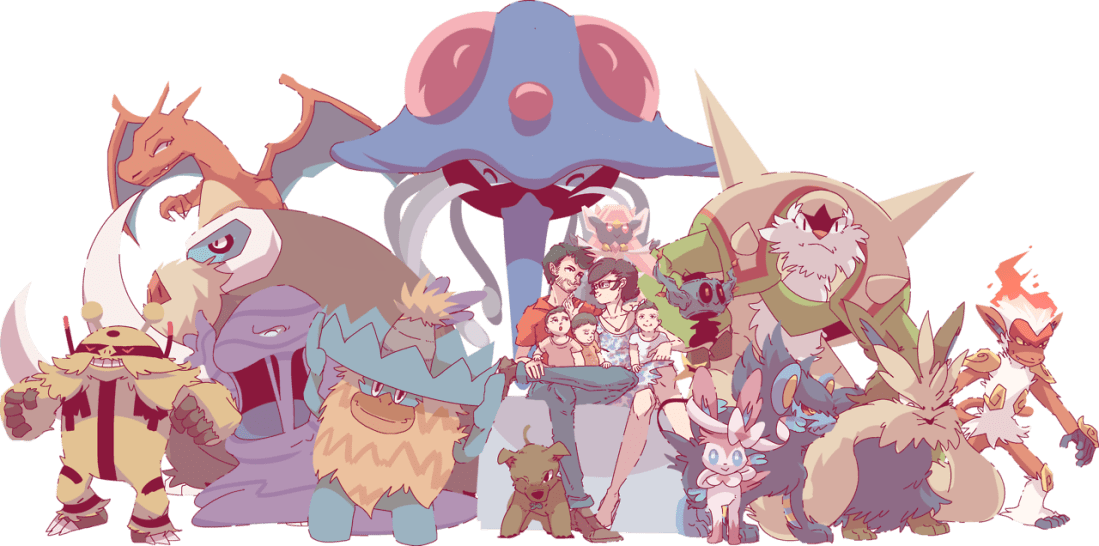
My wife and I had triplets not to long ago. We were finally able to get a family portrait together after hours of the photographer trying to get everyone in place and trying us trying to get our Pokemon to cooperate (along with our dog too!). Should we be worried about any of our Pokemon and the triplets as far as our Pokemon getting along with the new additions? Do you see any concerns here? So far Luxray seems to be the most protective of our bunch. Thoughts?


Bill: First and foremost, congratulations! You look like a wonderful family.

That said, though, my only concern is with your muk, rather than your luxray. Your luxray is displaying normal behavior around new additions, so I would only worry about it if it’s aggressive towards you whenever you try to take the children back.

Your muk, on the other hand, is a different story due to the fact that its body naturally harbors a wide variety of microfauna—or, in other words, potentially harmful bacteria and viruses. Newborns should be kept away from muk until you’ve started on their vaccination schedule at the very least (although really, preferably until their immune systems further develop), even if muk is eager to help.

Other than that, at first glance, it seems like the rest of your pokémon family don’t mind the presence of your children at all, which is a good sign. If that’s the case, then they likely understand how to regulate their power around the babies, meaning they’re docile enough to handle them without issue.

Best of luck to your family!