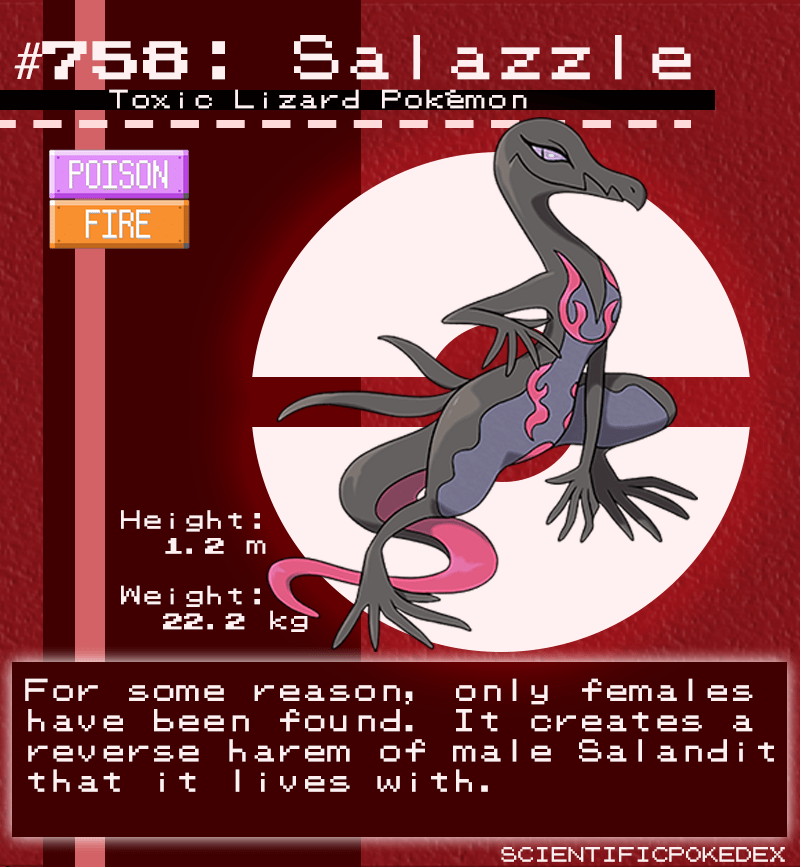
There’s quite a few pokémon that are all female, and Salazzle joins their ranks in gen 7. Only female Salandit are capable of evolving. It may sound strange, but there are quite a few organisms in our world that are like Salazzle, where only the females ever reach full maturity. Many of these species are parthenogenetic, meaning they don’t even need males to reproduce. They can still have sex, but even if they don’t, they can lay an egg that’s never been fertilized and the egg will still hatch. Whiptail Lizards, Komodo Dragons, Mole salamanders and some frogs are able to do this.
In fact, about one third of all whiptail species are entirely female: the male has gone extinct altogether. But, since there are still plenty of male Salandit around, Salazzle isn’t quite like these lizards.
Most animals (humans included) are diploids, meaning we carry two sets of chromosomes. Salamanders that are parthenogenetic often have three, four or five sets of chromosomes: this helps ensure that even though an egg might never be fertilized, it won’t be a perfect clone of its mother when it hatches. Genetic diversity is important for a species survivals: a group of identical clones would not survive for long.
So how can an egg hatch if it’s never been fertilized? In human reproduction, the child inherits half of their chromosomes from each parent. For example, for the chromosomes that determine sex, females have XX and males have XY. A child will inevitably get one from each parent, an X from the mother and either an X or Y from the father.
In a parthenogenetic example, the chromosomes that determine sex for a Komodo Dragon are called W and Z, not X and Y. It’s also a bit backwards from human reproduction: a male komodo dragon has ZZ, and a female has WZ. Each Komodo dragon egg laid by a female has either a W or a Z. In parthenogenesis, the chromosomes in the egg duplicate themselves, becoming either WW or ZZ. Just like YY is not an viable combination in humans, WW is a not a viable combination and will never hatch. ZZ, on the other hand, makes a male komodo dragon, so every unfertilized egg that hatches will be a male. Eggs that have been fertilized by a male can hatch either as male or female.
This explains why there’s so many more male Salandit than females! If a Salazzle’s egg is never fertilized, it will hatch into a male Salandit. If the egg is fertilized, it will be either a male or female Salandit.
Salazzle is a parthenogenetic organism: it can reproduce without having sex, and unfertilized eggs will always hatch into male Salandit.
Honestly though the most unrealistic thing about Ultra Beasts is that there aren’t huge internal debates within the Pokémon scientist community about how to reclassify non-human creatures.
“What the fuck are you guys even talking about there are literally no biological consistencies between Pokémon, we have everything from housecats to molecular jello to fucking sentient keychains, what does it even mean to say Ultra Beasts are a separate category of creature when Pokémon was never a coherent concept to begin with?!”
“You’re overthinking this. “Pokémon” is just our shorthand for “nonhuman.” Of course Ultra Beasts are Pokémon, everything nonhuman is. Therefore, the Ultra Recon Squad are also Pokémon.“
“Excuse you, but for a long time we have been able to make accurate descriptions of creature’s behavior by classifying them as Pokémon. If it fits in a pokeball, eats poffins, learns moves as expected, and even has the same type rules as the creatures on our planet, there is no reason not to call it a Pokémon”
“Bullshit. Ultra Beasts behaviors towards humans and wormholes are completely different than those of Pokémon, so we can define Ultra Beasts as a different set of behavioral traits.”
“You are all wrong. “Ultra Beast” is a term used to describe the origin of the creature. Pokémon live with us while Ultra Beasts came from beyond, there for they are a different thing”
“Wait but there *are* Pokémon from other planets and dimensions now”
“Exactly: we misclassified them. Clefairy, minior, lunatone, solrock, and similar creatures should properly be called Ultra Beasts”
“Fools. “Ultra Beasts” clearly only applies to extradimensional creatures, Pokémon were extraterrestrial from this planet in the first place. No, only Pokémon like Giratina should be reclassified as Ultra Beasts”
“Does the “spirit world” and other similar references count as a separate dimensional plane? Does this mean Ghost-Type is a type solely for Ultra Beasts?“
“Guys look you are missing the very important distinction between the two: aesthetic. Pokémon make you want to hug them with their cuteness, Ultra Beasts look like twisted abominations from someone’s nightmares. Therefore: we need to reclassify creatures based on how cute they are”
“Ultra Beasts are cute too what the hell are you talking about”
“How long have you been working on the storage system?”
“I’ve been with it since its inception, actually, so that would be—oh—several years now. My partner, a Kantonian named Bill, and I went to Celadon University together, and one day, he shared the original prototype of the system with me. Back then, it had a text-based interface and was nearly unnavigable, and I told him that under no circumstances could he release something like that to you poor trainers. He invited me to help him develop the system further, and I gave it a proper GUI and cleaned up his code a bit. The system saw a worldwide release only a few months after that.”
“Ooh, that sounds like a lot of hard work! Can you share what challenges you faced in implementing it?”
“Well, it was hard at first to convince people to want it in the first place!”
“Whoa, really?”
“Yeah. It’s a great idea, and the general public thinks so now, of course, but how do you explain it to people who have no background in quantum mechanics, engineering, or digital physics? I can’t tell you how many times my partner and I have had to convince others that the system is perfectly safe, that Pokémon don’t feel a thing when they’re transferred, that it’s impossible to delete or modify Pokémon as they pass through the system, and so on and so forth. If you can think of a question regarding whether or not Pokémon would be harmed as they pass through the system, I’ve had to answer it at least 10 times.
“And that isn’t even getting into the financial aspect of it. I won’t go into too many details about that for fear of boring you, but let me just say that convincing people to invest in putting a PC in every Pokémon Center turned out to be far, far more complicated than figuring out a way to turn living creatures into electricity and data.”
“Huh, I didn’t know that! But hey, since we’re on the subject… I’m sure I’m not the only one wondering this, but how does it all work? You know, the process of storing Pokémon?”
“Oh, I can’t tell you all the details, partly because some of it is a trade secret and partly because the full explanation may take more time than you’d probably like. Whenever any of us—Bill, myself, or the other administrators, I mean—whenever we’re asked this, we often compare it to a telephone. Basically, a telephone works by converting the sound of your voice into electrical pulses, sending those through a wire as electricity or through the air as radio waves, and converting those pulses back into your voice on the other end. The storage system works in a similar manner. The matter converter breaks down a Poké Ball, draws it into the digital matrix, and sends it into our cloud-based system until you specify a destination whenever you withdraw a Pokémon. There’s a bit more to it than that, but then we’d have to get into the nature of Pokémon and how it’s possible for them to perceive their surroundings, even in an electro-digital state such as the one they assume inside a Poké Ball, and that gets a bit messy.”
“It all sounds so complex and fascinating. I’m sure I speak for everyone when I say that I couldn’t imagine being a trainer without the storage system! Is there anything you want to say to all the trainers out there whose lives have been made easier because of your work?”
“Much of what we do isn’t for you; it’s because of you. So the first thing I’d like to do is thank our users, not only for using the system but also for going out, exploring the world, and discovering new and exciting things. In turn, you inspire us to create and explore, and with your help, we come that much closer to understanding the Pokémon we share the world with. And with that said, second, never stop being curious. Keep exploring, and keep befriending the people and Pokémon you meet.”
Lanette’s dialogue was written by @bills-pokedex! Her blog is this awesome project where she writes Pokédex entries as the Pokémon researchers Bill and Lanette, and it also doubles as a platform for trainers to ask for advice! There was no one else I would’ve considered for writing the Lanette conversation, and after reading this, I’m sure you all see why. Be sure to check her blog out! 🙂
{Congratulations to @trainersofhoenn for two awesome years! As someone who lurks this blog like whoa, it was fun to collab with the voice behind Brendan and help celebrate a highly ambitious and creative fan project.
Also? If you’ve somehow never heard of this blog, give it a look! You know how Humans of New York is all about sharing the unique stories and struggles of the everyday human being? Trainers of Hoenn does very much the same thing, only it’s one person running it, and it’s all about Pokémon characters. You get a story on your dash every day, and each one adds depth and character to even the most ordinary-looking NPCs. It’s funny sometimes, it’s heartwarming at others, and it’s all-around fun, period.
Thanks to the blog’s mod for the collab, and congrats again for another year!}



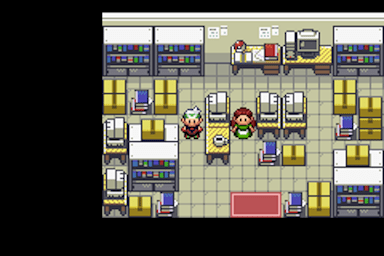
 The Pokédex According to Bill